|
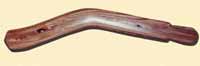
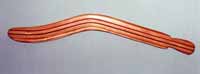
Through History throw sticks were equally as popular amongst early civilizations as were boomerangs. Probably more so amongst the earliest of civilizations. Pictured at right is an original throw stick of long ago and below that is an original boomerang of long ago. There exists a common myth that boomerangs were used for hunting and that they were found in Australia only. The picture belief created to most readers is that boomerangs were used to kill Kangaroo's and that once a boomerang was thrown at a Kangaroo the boomerang would hit the animal and return to the thrower so the thrower wouldn't have to chase the curved stick. The other misunderstanding was or still may be that in the event the thrower would miss the animal then the boomerang would come back without having to chase it. This scenario is untrue.

Simular to making boomerang plywood, molds are made for throw sticks.
Like boomerangs throw sticks were used around the world and were the first thing to be thrown by man toward an animal (other than rocks and stones). Featured in this section are various laminated throw sticks made by the author.
In 1933 throw sticks were discovered (amongst other related items) in the tomb of Egyptian Pharaoh Tutankhamun. King Tutankhamun died around 1356 B.C. Dozens of throw sticks from ancient Egypt can be found in the Egyptian Museum. Some of these early throw sticks were made from the hardwoods from that area. Some were carved from Ivory with gold caps on each end. Some were made from Ebony with beautiful bark wrappings.
Today throw sticks have a popularity for collecting purposes, decoration and for use in competition. Throw stick competitions are quite extraordinary. Custom made throw sticks are designed for various World, State and Provincial competition. Competition categories include: accuracy throwing, long distance and endurance throwing in rough terrain. A well made and well tuned throw stick can be an impressive item for competition and recreation as well as for home or office decoration. Accuracies can be obtained up to 80 and 120 meters. In addition, throw sticks can be a thing of beauty being made from exotic hardwoods with various options for inlays such as bronze, Ebony and Rosewoods, Bone, Teak and so on.
Generally, as much design, tuning and contouring can go into making a throw stick as it can a boomerang. Some throw sticks require lead or bronze weighting and balancing to achieve great distances and proper flights. Throw sticks are made from quality plywoods, strip laminated hardwoods and from tree limbs with a natural bend. The photo's marked T2 show two throw sticks made from the limb of an apple tree.
The group of throw sticks in the photos represent both strip laminated (top) and plywood models with brief descriptions.
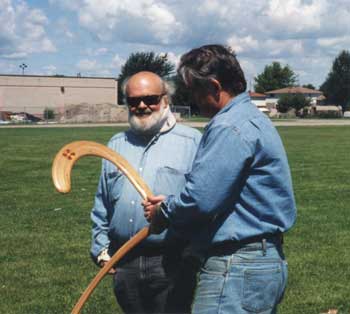
Pictured at Right is the author demonstrating the Wilhelm Bretfeld design. We must give all credits to Wilhelm for this unique design. Although Wilhelms intent was to create a boomerang of this shape the author increased the thickness to 12 and 18 MM to produce a very strong and accurate throw stick that actually returns. Notice the exotic inlay work in the radius portion of the throw stick.
(A) Throw sticks come in many sizes and shapes as is featured in the various photographs. Some throw sticks are made with alternating strips of hardwoods that create true masterpieces. Also, featured is a hardwood throw stick with a close-up of the weighting for distance and performance.
|

Original Throwsticks from early civilizations. Most throw sticks range in length from 50cm to 120cm and can weight from one - 3 pounds


|