|
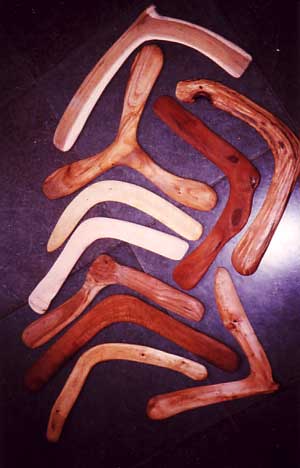
Natural elbow boomerangs are boomerangs that have a natural shape to them without being strip laminated or cut out of plywood. Natural elbow or natural shaped boomerangs are any boomerang shape that grows that way. Natural elbow or natural shape boomerangs are cut and contoured from tree limbs or from the roots of trees as identified in some of the photo's featured on this page.
Natural elbow boomerangs are by far the most beautiful and elegant of all the boomerangs boasting enhanced natural grain and overall unique patterns that only nature could produce. Although natural elbows are good flying boomerangs most prefer to hang them for decoration and conversation. Natural elbows are made from any wood except for some of the more exotic woods having just too much density and weight. Apple, pear, Walnut Sassafras, Maple, Beech, Hickory, Oak, Chestnut, Cherry, Hawthorne, Ash, Hemlock, Yew, Osage, Butternut, Mulberry, Locust, Willow, Elm, Peach, Arbutus, Magnolia and Pawpaw all make great natural elbows, although the density and weight of each varies substantially.
Photographs on the right feature the natural elbows made from some of these trees(Not Made by the Author). Natural elbows are much harder to find and properly cure therefore the cost reflects the difficulty with their production.
Unnatural Elbow
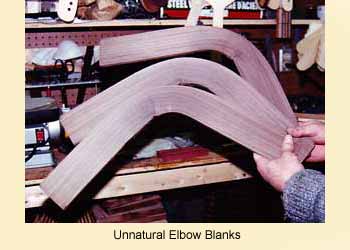
Unnatural elbows can be almost as elegant as the natural elbows. An unnatural elbow is a boomerang that is forcibly bent into a desired shape. Radial cut logs, that is to say, logs cut in a way to produce lumber with proper grain direction that can be successfully steam bent are used in the steam bending process. Lumber is usually cut about 10cm X 10 cm x 1 meter in length. This solid piece of lumber is placed in the authors steamer for about 2 hours (depending on the wood and its density). At this point the thick piece of lumber is removed from the steamer and placed on a flat table. With the use of a steel strap and a winch system the thick piece of wood is slowly bent around a secured radius (usually a metal post affixed to the top of the table). The thick piece of wood is allowed to dry for two or three days ( depending on the relative humidity).
The thick piece of wood is then sliced into strips about 6mm to 8mm thick to produce a number of unnatural elbows. Photo's UN1 shows what the slices of wood look like before they are cut to the shape of the boomerang. The Slide Show photo at Right shows what the boomerang in this case will look like when it is cut and contoured and what the boomerang looks like when finished in a dark oak. The Slide Show At Right also shows what a walnut unnatural elbow looks like when finished with a clear coat.
|
|