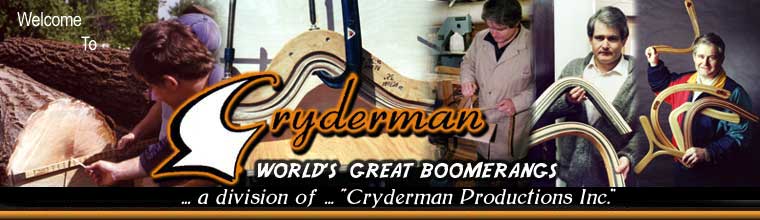
CHATHAM — John Cryderman is ignoring the fact that boomerangs are commonly associated with Australia. So much so, that the Chatham native has worked for royalty, which may land his name in the Guinness Book of World Records.
Cryderman's game is designing and producing boome- rangs, and dispelling myths about Down Under's most famous 'slick.'
He had heard that Prince Charles had a special interest in boomerangs. About 18 months ago, Cryderman used the help of the federal government to send boomerang sketches to the prince, showing boomerangs Cryderman could make for him.
To his surprise. Prince Charles accepted the offer,saying he was looking forward to the gift.
Valued at more than $20,000 by the World Boomerang Association, the two royal boomerangs, placed in an elaborate walnut case, travel to England on Friday, to be presented to Prince Charles by Richard Baron, president of Chatham based Baron Insignias Inc. Baron's company laid in gold and silver insignias on the two boomerangs. One insignia depicts Prince Charles on horseback playing polo.
A FORMER CHATHAM policeman, Cryderman said he fulfilled "a lifetime dream" by making the boomerangs for the prince. Cryderman's 'rang customers cover the globe, so he was too busy to personally make the delivery.
A record of Cryderman's gift was also submitted to the Guinness Book of World Records in New York as the world's most expensive boomerangs.
Cryderman said it took him about 400 hours to design and construct the royal boomerangs. One boomerang consists of laminated Canadian walnut. The elbow section is rosewood and ebony: the wing tips are horizontally laminated from a burled Honduras rosewood that's so rare, it costs $45 a pound.
The elbow section is a gold inlay of wheat to depict Canada as a world leader in grain export while also honoring the Royal Family's concern with global famine.-Each wing has the prince on horseback.
The value of the gold and silver and their molds is about $7.000, Baron said.
The elbow section of the other boomerang is constructed of steam-bem Canadian walnut, vertically laminated for extra strength and to prevent warping. The orange portion of the wings are horizontally laminated from Burmese and African paduk. The tips are inlaid with Honduras burled rosewood.
THE CASE, WHICH Cryderman also built, was mide of two-inch solid walnut and weighs more than 80 pounds, The top of the case is inlaid with two solid walnut boomerangs representing a smaller version of the boomerangs inside. The hardware is solid bronze and brass.
The wood he uses in ordinary boomerangs ($20 - $30) is white oak, which he buys from Ontario suppliers. And because the wood is steam-treated, Cryderman constructs several dozen at a lime.
He doesn't know how long it takes to make a boomerang but, "I guess I get about $1 an hour to make a $20 boomerang."
Cryderman figures his one-man operation is the lone boomerang producer in Canada, and knows of a few private companies in the United States. He started making boomerangs in 1978, after reading a magazine article in a dentist's office. The executive producer of Chatham-based Cryderman Productions Inc., finds himself promoting consumer, trade and recreation shows during the day in a home office, and then burning the midnight oil in his basement workshop making boomerangs.
Cryderman said there are several stories about where the boomerang originated; but he doubts it was Australia. "Recent archeological evidence suggests a far more diversified history for the non-returning style boomerang, also known as the hunting stick," Cryderman said. "The early Egyptians hunted birds with them along the Nile and specimens were found in King Tutankhamen's tomb."
THE HOPI INDIANS of North America and early European tribes are also known to have used them, he said.
"Experts estimate one 'rang discovered in a Florida marsh in 1976 as 9,000 to 10,000 years old, while another, unearthed in a Polish cave in 1987, is said to be 23,000 years old," Cryderman said.
As competitors rediscover the thrill of the throw, 'ranging is now booming all over the world, he said. The World Boomerang Championship is held annually around the globe and draws competitors from some 500 boomerang clubs.
At last year's competition in Perth, Australia, 33-year-old John Koehler, an advertising agency art director from Maryland, beat out about 70 participants from nine countries for the title.
"They proved Aussies have no lock on the game," said Cryderman, wlio tried in vain to have the world championship in Chatham.
The competition consists of five events: Distance throwing, maximum time aloft, trick catching, fast catching and doubling (throwing and catching two boomerangs).
Two boomerangs exist — returning and non-returning, also called hunting sticks.
The hunting sticks were used as a weapon, he said, because they are heavier, stronger and very accurate when thrown by an expert. This type of boomerang has a shallow curve in relation to its length, which is two feet to three feet, and weighs up to two pounds. Much heavier and larger than the returning boomerang, the hunting stick would cut a straight path through the air and hit hard for the kill.
"Generally, the returning boomerangwas quite light, between two and 10 ounces. As it was developed, its aerodynamic behavior improved,* and it seems reasonable to suppose that it was never intended to be a lethal device." . This type is a light, thin, well-balanced boomerang from 12 to 30 inches, two inches or three inches in width, and three-sixteenths 10 three-eighths of an inch thick.
THE MOST IMPORTANT technical feature of the returning boomerang is the twisting of the ends in opposite directions, one forward and one backward.
The throwing of a returning boomerang, Cryderman said, requires the grace of and timing of a golf or cricket stroke. The action is vigorous, and the thrower runs a few steps forward to gain greater impetus. The boomerang is held at one end, over the shoulder and behind the thrower's head. It's swung rapidly forward and before release is given added momentum by a wrist snap.
"Although boomerangs can be made out of materials' ranging from pizza-box tops to fibreglass, plastics, plexiglass, bone and carbon fibre, nothing surpasses the traditional beauty of wood," Cryderman said. And there are right-handed and left-handed boomerangs.
Cryderman said a boomerang's wings have the same aerodynamic design for lift as those on an airplane. Re- turning boomerangs can be thrown 150 yards before returning.
"They are so accurate, experts play a game called William Tell. Yes, they put an apple on their head. On its return, the boomerang cuts the apple in half."
Cryderman offers one guarantee: The returning boomerangs he makes "do return."
"A novice can throw one and look like a hero." He says every boomerang he makes is tuned like a violin, before it leaves his workshop.
Besides making them for collectors, competitors and royalty, Cryderman also sells less expensive ($22) returning boomerangs to stores in the Chatham area.