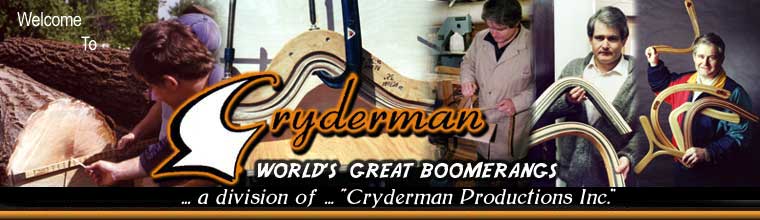
When a business person meets someone for the first time, odds are that he or she will be handing out a business card as a remindier of their name, phone number and the business associated with them. When I came into contact with John Cryderman of Chatham he sent me a pile of business cards - more than half-a-dozen - all of which were his. I wouldn't be surprised if you looked up the word eclectic in the dictionary and saw John's picture beside it. Besides being a collector of airguns and woodworking tools, he breeds rare and exotic turtles, has a profound interestin ornithology, organizes trade shows both in Ontario and as far away as Kamloops, B.C., and oh yes... makes and sells boomerangs.
Yes. boomerangs. This is more than just a passing fancy, in case you're wondering. To be precise, John first got involved with making boomerangs when he was seven or eight years old. His first attempts at making boomerangs way back then weren't too successful, but he has improved his technique over the years. John now creates many different styles and sizes of the 'booms' and fine tunes each one himself so that their flight patterns are perfect. They are all flight tested to perform beautifully under average conditions. John claims that his boomerangs will make even a beginner look like a professional thrower. Although every flight can't be perfect, the idea is to have a beginner throw the boomerang for the first time and to have it fly in a graceful arc that will bring it back to the thrower. At this point, the thrower should be in the early stages of being hooked on the sport of boomerang throwing.
Most people are under the impression that boomerangs originated in Australia with the Aborigines who used them for hunting food. This presumption is wrong on both counts. The oldest known boomerang was found in Poland and carbon dated as being over 23,000 years old! The true, returning boomerangs were not used for hunting either. They were purely recreational, being thrown just for fun. There is evidence that they have been used for flushing out game, but not for the actual hunting itself. The name of the item which is actually used for hunting small game is a throwing stick. These contraptions are not curved as much as boomerangs and consequently do not have the aerodynamics needed to cause them to return to the thrower.
 They do have to be tuned, however, to ensure that they too have accurate flight characteristics. Accuracy while throwing along a straight line is the key for hunting with throwing sticks. John makes and sells these as well.
When researching the history of boomerangs, John discovered that besides the Poland discovery, throwing sticks and boomerangs were found in the tomb of King Tutankhamun in Egypt. These were made from ebony and other kinds of wood, as well as some ritual throw-sticks made from ivory. A great number of them were found in the tomb, indicating that they were widely used during his era.
MAKING BOOMERANGS
John makes his boomerangs from Canadian hardwood. Some of the species that he uses are Oak, Ash, Walnut, Hickory. Tulip. Locust, Maple, Cherry. Apple and Chestnut. The actual trees from which the lumber is cut are hand-picked. John actually looks for certain trees that are growing on the edge or in the centre of a woodlot. The edge location means that the sun only hits the tree on one side, thus starving the other side of the tree and inhibiting branch growth. Trees located in the middle of the woodlot do not get get direct sunlight in the early stages of growth, thus inhibiting the growth of branches on the lower portion of the trunk. The key to getting wood
suitable for making boomerangs is to get a tree with a trunk that has minimum knots and irregularities in the grain. Once an acceptable tree is found, it is Felled and quarter sawn into boards about 2" thick. Quarter sawing is necessary so that when 1/4" strips are cut from the boards, the grain of the wood will be running in the right direction. What John wants is to have the grain running top to bottom when the boomerang is finished being laminated. This will help to prevent warping or other problems if the wood shrinks slightly after construction.
 Dendrochronology, or the studying of a tree's growth rings, also comes into play. Once the tree has been cut into appropriate lengths, its rings are examined to determine the relative density of the wood Early wood refers to a trees growth pattern as it begins its seasonal growth cycle. At this point, the tree is usually growing faster, producing the wider and generally lighter portion of the annual growth ring. Late wood, where the tree is ending its seasonal growth (growing more slowly) has cells with thicker walls and more fibrous material, producing the darker portion of the ring. According to John. "There .s a give and take equation here in the battle between early and late wood growth for steam bending as far as which could be the best. Depending on the thickness and degree of bend, the amount of natural moisture, the amount of steam time and the type of wood being bent, late growth, in my experience has the edge over early growth wood." Kiln dried lumber, such as you would purchase at a lumber yard, is never used by John because of damage done to the lignun during the drying process. The lignun is the wood's natural elastic fibres which allows the wood flexibility for bending.
The wood is steamed to make it more pliable for bending before it is clamped into the mold. This doesn't actually add moisture to the wood, but boils the natural moisture already present in the cells of the wood thus softening it. Once the hardwood strips are placed in the mold to shape them, they must be dried down to a moisture content of between 6-8%. This is accomplished by using a custom-designed drier, consisting of a blower, an air-conditioning unit and a dehumidifier. The latter two components are necessary only in the humid months of summer.
After the strips have dried, the lamination process begins. Now the different strips of wood will be glued to each other to lorm the boomerang or throwing stick. Selecting the proper glue for this job is essential to the success of the project. Polyvinyl resin glue (white glue) is water soluble and therefore should not be used in boomerang construction. The same is true for yellow glue (aliphatic resin adhesive) which also has a nasty habit of clogging up sanding belts or drums when contouring the boomerang wings. John recommends thermo setting glues such as resorcinol or urea resin.
Wood is constantly changing, according to John. Even after it has been cut into lumber, it will still expand and contract with moisture. Therefore, when the boomerang blank (2 1/2" thick approx.) emerges from the mold, it is sealed with a wood sealant, especially the ends which are more susceptible to moisture. A plywood pattern is placed on the laminated blank, traced and then cut out using a bandsaw. From here, the boomerang is roughly contoured on a pneumatic drum sander. Next, the boomerang is clamped to vice jigs which allow more accurate contouring and smoother blend- ing of the wings into the elbow section. The final shaping and smoothing is done by utilizing progressively finer grades of sandpaper.
 Finally, the boomerang is tuned, field tested for flight qualities, then retuned. All that now remains is to give it a finish with numerous coats of a hand rubbed urethane or varathane mixture. Each boomerang is then weighed, measured, signed and stamped.
Boomerangs are a business too. Crydermaii Boomerangs market over a hundred different styles and sizes of boomerangs and throwing sticks. Currently, John estimates that he is custom producing a couple of boomerangs per week. A cat alogue is available that shows all of the different models that John makes. There is also an internet site at:
These items have received some very high praise from people who are involved in using boomerangs both competitively and recreationally. He has sold 'rangs to people world-wide (even to people in Australia.)
THE PRINCE OF WALES
One of the most amazing and rewarding things that has hap-pened since John got into the business of making boomerangs was the opportunity he had to make a custom set of boomerangs for His Royal Highness, Prince Charles. This was quite a privilege - one cannot just give something to the royal family. You must first go through an official who in turn will approach the family for you. The prince rarely accepts gifts from the public - only if he has some personal interest in the gift and if the presenter has put special thought and effort into creating it. However, John did receive a call from the British High Commission in Ottawa telling him that the prince would accept his gift.
These twin boomerangs were special indeed. They were crafted from a variety of exotic woods. On the wings are two figurines made of solid 18k gold, showing the prince playing polo. The wing tops have a detailed princes' crown also made of 18k gold. The detailing on the horses boast 22k gold hooves as well as the Princes' polo stick. The horse's reigns are in sterling silver.
The case in which the boomerangs rest is amazing as well. Made from walnut with padded cow hide cushions, it is highlighted with Indonesian rosewood, silver and bronze. The estimated cost of the entire project was $9,000, but John sees a reward worth more than that from the satisfaction he received from this project.
An amazing side-note to this story is that John had received permission and had made arrangements to go and present the boomerangs himself. But instead, he gave up the trip to let a neighbour and his children go in his place. It's hard for me to imagine giving up a trip like that - flying into Heathrow airport, being met by the British Honour Guard, being whisked out without going through customs and then being loaded into a Rolls Bentely limo and then being driven straight to St. James Palace. Not bad as far as the economy tours go.
THROWING BOOMERANGS
Throwing a well made, well tuned boomerang properly is not at all difficult. However, one must realize that in any sport or recreation safety and caution are most important. A person shouldn't ride a bicycle in a reckless fashion nor should a person throw a boomerang recklessly.
It makes a difference if you are right or left handed - left handed people should be sure that the boomerang they are throwing was designed for a left handed thrower. Basically, you hold the boomerang with the flat side against your index finger and your thumb on the curved top. Tilt the boomerang over rather than holding it perpendicular, but not so far as to be throwing it sidearm (throwing sidearm causes a dangerous flight pattern.) You don't need to throw hard and remember to follow through after releasing. Face into the wind, then turn approximately 45˚ to the right (assuming you are a right handed thrower.) Do not aim too high. The results of your throw, if it is less than successful, can tell you what adjustments you need to make. If you are serious about doing this, vou should look into this in more detail on your own. Some points that you should keep in mind are:
• always keep your eye on the boomerang after you have thrown it.
• never throw a boomerang like a frisbee.
• never throw a boomerang sidearm.
• do not try to catch your boomerang if it is coming towards you too fast.
INTERESTING FACTS
Did you know...
• boomerangs utilize all of the same principles as airplanes?
• the record for MTA (maximum time aloft) is 17 minutes, 42 seconds for a single throw?
• there are over 20,000 boomerang competitors worldwide?
• U.S., France and Germany are the countries most involved?
• the next world championship will be held in St Louis, Missouri?
Well, now you know. If you are interested in boomerangs and would like to know more, you can contact John through his internet address listed earlier in the article. Who knows - maybe you'll catch boomerang fever yourself! •