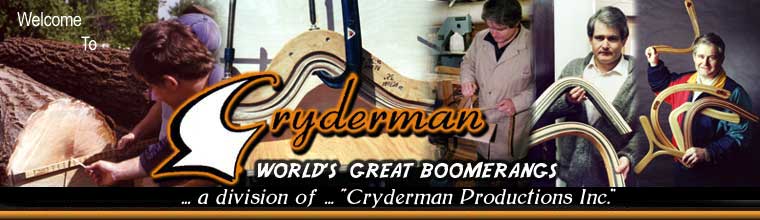
Craftsman goes back to his childhood love by building boomerangs
By MARNIE TAYLOR
Daily News Staff Reporter
 JOHN CRYDRRMAN has turned a childhood fascination with flight into an art form. Cryderman, who recently moved to Kamloops from Surrey, constructs and sells boomerangs — a thin missile of curved wood that when thrown, returns like a well-trained falcon.
It's an intricate and precise craft, involving much more than carving out a banana-shaped piece of plywood. Cryderman said it's taken years to properly develop his technique, after becoming initially interested as a child.
"I think all kids look at (boomerangs) with fascination and wonder why do they come back. The interest stuck with me for years before I decided to do more research," he said. Contrary to popular belief, boomerangs were not used for hunting, said Cryderman. The boomerang is too light and would never return if used to strike an animal.
His research indicates the objects, were used more for entertainment value than warfare. It's also a myth that boomerangs originate from Australia, he said. I've found them dated back hundreds of years ago to Poland and eastern Europe. They didn't originate in Australia at all," he said.
What Cryderman also discovered is there is more mathematics to constructing boomerangs than there is woodworking. Angles, lifts, torque, wind speed, shape and weight all play a part in getting the flying machine to return to its sender. "Everything that makes an aircraft get off the ground applies to boomerangs. It's like a science," he said.
Depending on its construction, the boomerang can reach speeds up to 100 kilometres per hour. It can travel the length of a football field or less than two metres. The type of wood used to construct the boomerang is important, as it must be strong and dense but also very flexible. Cryderman said ash, hickory, cherry, oak and walnut are all favorable construction materials.
Like a good piano, a boomerang must be tuned if it is to fly properly, he said. Once shaped, the wood is steamed and twisted, which aids in its flight. Its lift at either end will deter- mine how much height and distance the boomerang can travel.
" There's no trick to it. A proper boomerang, built right and taken care of, will always come back."
The business of boomerangs is not yet a big one in Canada, said Cryderman,even though there is a Boomerang Association of Canada. Although he doesn't compete himself, Cryderman does build the boomerangs for other competitors. The flying objects range in price from $25 to $300 and can take anywhere from a few hours to a few days to build.
Cryderman plans to give boomerang demonstrations in conjunction with the Kamloops Woodworkers' Guild at a woodworking show at the KXA Oct. 16-18.