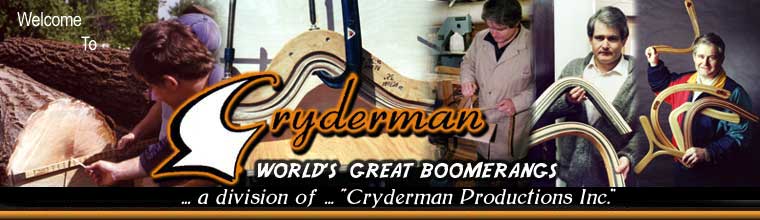
John Cryderman's boomerangs are fit for a king. Or at least for a king to be.
 When John originally contacted the British Embassy with an idea for a royal boomerang, he received a lukewarm response. After submitting a sketch of his proposal, however, he received a phone call from the British High Commission, requesting two handcrafted boomerangs for Prince Charles.
"They're the most expensive boomerangs in the world," John said. While the actual cost of the two boomerangs was only $9,000, his 400 hours of labor would put the selling price of the donated boomerangs to $22,000.
Grafted from horizontally lapped laminated exotic woods, he carved out Prince Charles riding his polo pony. The polo stick and horse hooves were outlined with solid gold, with silver outlining the reins. Prince Charles himself sparkles with 18 karat gold. The Canadian symbol of sheaves of wheat glow with gold, as well, and the Royal Crowns at the boomerang tips were decorated with cow bone, mother of pearl and gold.
The precious boomerangs rest in a two inch thick buried walnut case, the case itself decorated with Indonesian rosewood, bronze and silver. Prince Charles himself wrote John to thank him, adding that he doubted he'd ever throw the artistic boomerangs.
John personally chooses the trees that he uses to create his boomerang art, and then he specifies how he wants the trees cut. "After the trees are sliced into boards, I store them in a type of greenhouse, because if the wood has less then twenty percent moisture, then it's difficult to work with. When I'm ready to make the boomerangs, I cut the wood into 8 or 10 inch strips. Then, I put them into steamers until they're pliable."
 His customers select which of the 150 boomerang shapes they'd like their finished product to be, with 55 of these shapes totally original creations by John. He then clamps the strips into a mold, creating a two inch thick boomerang. "Of course/ no boomerang this thick would fly, so I slice this into five or six quarter-inch thick boomerangs."
While a typical boomerang takes John between one week and three months to complete, he has spent up to three hundred hours on a single long distance boomerang. "When I'm finished, the boomerang is perfectly tuned, perfectly balanced, with exact air foils," he added. "It is hand honed, with even the resins and hardeners weighed first, for a perfect balance."
While he handcrafts boomerangs with high quality oak, ash, walnut and cherry, he expects you to throw and catch them. "My motto is—if you can eat a bowl of jello with a spoon — you can throw any one of my boomerangs and look like a professional thrower'. John's instructions read. "They are eloquent, made like a piece of furniture, nice to have and are great for recreation and sport, and are affordable to everyone."
A resident of Canada, Cryderman first started creating boomerangs while working as a furniture maker. "I want my boomerangs to be the Cadillac of strip laminated work," he said. "It's my specialty."
He also enjoys putting on boomerang demonstrations and workshops. "I like to explain the historical significance and the evolutionary history of the boomerang, explaining the perspective behind boomerangs versus hunting sticks," he said. "I don't want to sell a million boomerangs a year, but I'd like to help people appreciate them."
While John lives in Canada, he points to several Americans as his boomerang inspiration. "Ted Bailey is an incredibly knowledgeable man, Eric Damell is amazing and Chet is a fantastic competitor," he said. "These guys are the cream of the crop."