This section will give you an idea how the strip laminated boomerang is made. The following description and photo's will explain why the Strip laminated boomerang is the Mercedes of the boomerang world................................
The strip laminated process allows for the ability to control the weight displacement factor of each boomerang. With plywood models the weight of the plywood is consistent, with strip laminated hardwoods the weight can vary with thicker airfoils (wings) to improve some flight qualities. When thickness and weight can be varied it creates a better flying machine.
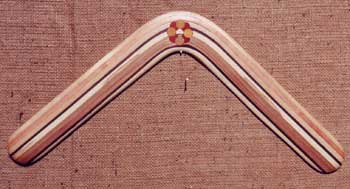
Although complicated the strip laminated process truly creates the Mercedes of boomerangs for both flight, looks and investment value. The hardwoods used are: Walnut, Cherry, Ash, Hickory, Maple, Elm, Apple, Aspen, Red Oak and White Oak, Chestnut, Birch, Beech, Butternut, some Mahogany's, Sassafras and Yew.
INLAYS: Some of the woods used for beautiful inlay work include...African Blackwood, Brazil wood, Bubinga, Cherry, Coco bola, Ebony, Kingwood, Pad auk, Purple Heart, Rosewood, Wenge and Zebra woods.
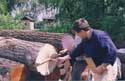
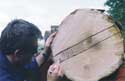
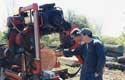
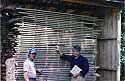
STRIP LAMINATED BOOMERANGS START WITH..... selecting the proper tree from the forest (under managed authority to be cut) having a straight trunk with minimal knots as shown in photographs (1), (2), (3) & (4).
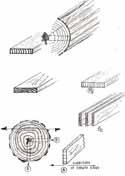
B & A -Identified by the dotted lines showing how the tree has to be cut at the sawmill to get radial cut lumber.
B1 -Shows what the lumber is like with the grain direction running from top to bottom
B2 -Shows the 6mm thick strips cut from the lumber used for steam bending
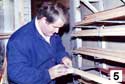
Photo (5) shows John Cryderman checking the moisture content of the 6mm strips of hardwood. If the moisture content falls below 20% natural moisture the wood becomes increasingly difficult to properly steam and bend.
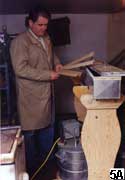
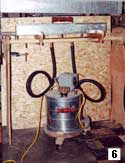
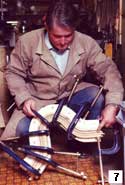
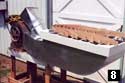
Through the use of an electric water steamer( as shown in photo "5A") the hardwood strips are placed into one of the two metal steam boxes as shown. The steam boxes are different lengths due to the various sizes of boomerangs. Once the hardwood strips are steamed to be pliable ( usually 20 minutes) the hardwood strips are taken from the steamer and while still damp and soft are anchored into plywood molds ( as shown in photograph "7"). The strips will remain in the molds for one or two days or until they dry to a moisture content around 10 to 14% which depends on the relative humidity. The hardwood strips are then removed and separated to assist in drying faster and to a lower moisture content. In some cases air is blown around each hardwood strip ( with a custom made blower as shown in photograph "6") to help speed the drying process, however, the lowest content of moisture is dependent on the relative humidity.
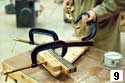
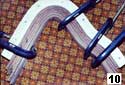
Glue is then applied to each hardwood strip and the strips are then re-clamped into the mold and left for drying. Before the strips are re-clamped into the mold wax is applied to he mold to prevent the wood strips from being glued to the mold when the glue squeezes out when clamped as shown in photographs "9" and "10".
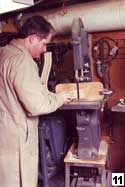
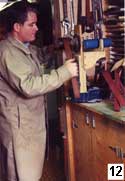
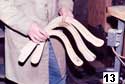
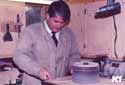
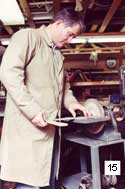
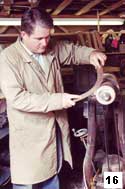
The laminated block of strips is then removed from the mold and cut into 6mm thick boomerang blanks as shown on the band saw. in photograph "11" and in photograph "12". From this point onward the 6mm boomerang blank wings are contoured on the pneumatic drum sander as shown in photographs 14 15, 16, 17.
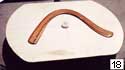
Before the final finishing each boomerang goes through a final contouring stage. In the case of some long distance boomerangs lead weights are added to help achieve great distances. Long distance boomerangs are generally weighed and balanced as shown in photograph "18".
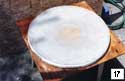
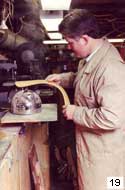
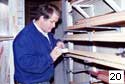
To get that almost perfect tuning a custom made concrete tuning dish is used ("17") the concave of the dish is taken from a 3.6 meter radius. This radius degree of tuning works well for most hook style boomerangs by affording the proper dihedral and attack angle for each wing - just like an airplane. To get the proper tuning the strip laminated boomerang goes through the same steaming process as the plywood models whereby the wings are steamed as shown in photograph "19". The boomerang is then checked again to make sure the steamed in tuning remained during the cooling cycle. See photograph "20" showing the wing lift when the boomerang is pressed flat onto the piece of granite.
One sealer coat is put onto the boomerang. The boomerang is then field tested for proper flight, taken back the workshop where up to 6 protective coats are applied.
Some boomerangs are ordered with the optional exotic wood inlays as shown